
26.183 - The Difference Between Belonging and Fitting In
“To be yourself in a world that is constantly trying to make you something else is the greatest accomplishment.”
— Ralph Waldo Emerson
🧩🧍♀️✨
The Acceptance That Edits You
There is a profound difference between being accepted because you have adapted and belonging because you are known. The two experiences can look similar from the outside. In both, a person may be invited into the room, included in the conversation, welcomed into the family system, hired into the organization, or recognized by the group. The difference is not always visible socially. It is felt internally.
Fitting in asks, “Who must I become to be accepted?” It begins with the room and works backward toward the self. The person studies the expectations, detects the safest version of themselves to present, and edits whatever seems likely to create tension. Sometimes the editing is subtle. A person laughs a little more than they mean to, softens a disagreement, hides a private grief, mutes an ambition, conceals intelligence, performs ease, or becomes agreeable before anyone has asked them to.
Belonging asks a more truthful question: “Can I participate without betraying myself?” It does not reject adaptation, courtesy, restraint, or social intelligence. Human beings are relational creatures, and no mature life is built by saying everything without regard for context. Belonging is not the refusal to adjust. It is the refusal to disappear.
This distinction matters because many people mistake successful adaptation for genuine belonging. They know how to be liked, useful, polite, impressive, entertaining, calm, productive, attractive, or easy to have around. They know how to reduce the friction of their own presence. From the outside, they may appear connected. Inside, however, they may feel strangely absent from the very relationships and communities that appear to include them.
Fitting in often produces relief before it produces exhaustion. It gives a person a script, a strategy, and a way to reduce social risk. It can be intelligent, especially in environments where difference has consequences. Yet over time, the cost accumulates. The person may begin to feel accepted but unknown, included but unseen, praised but not present.
Belonging does not mean every part of the self is constantly displayed. It means the self does not have to be fundamentally falsified in order to remain connected. A person can still be tactful, private, selective, and emotionally disciplined. The essential difference is that they are no longer organizing their presence around the fear that truth will make them unacceptable.
July begins with this distinction because belonging is not a decorative emotional ideal. It is one of the central conditions of a livable life. A life cannot become whole if it is built only around the versions of the self that others find convenient.
The Scripts That Teach Us to Disappear
Modern culture has become highly skilled at rewarding fitting in while speaking the language of authenticity. Workplaces often encourage people to bring their “whole selves” to work, but only within the boundaries of what the institution can comfortably metabolize. Employees quickly learn which questions are welcome, which forms of emotion are professional, which kinds of disagreement are considered strategic, and which kinds are labeled difficult. The professional self becomes a managed performance: engaged but not disruptive, confident but not threatening, honest but not inconvenient.
This does not mean workplaces are uniquely false. It means institutions create scripts, and people who depend on those institutions learn to read them. The employee who wants to remain safe, promotable, and respected may become fluent in the approved tone of the organization. They may learn when to speak plainly, when to soften, when to remain quiet, and when to translate their perception into language that will not trigger resistance. Some of this is maturity. Some of it is self-protection. Some of it is the slow conversion of a person into a role.
Family systems create another kind of script. One child becomes the responsible one, another the charming one, another the difficult one, another the successful one, another the peacekeeper, another the one who never needs help. These roles can persist long after everyone involved has changed. A person may return home as an adult and feel the old costume waiting at the door. If they refuse it, the family may experience their growth as a disturbance.
In families, fitting in is often mistaken for love because the familiar version of the person is easier to recognize than the living one. The person who changes may be accused of becoming selfish, distant, arrogant, cold, dramatic, or ungrateful. What is really happening may be simpler and more unsettling. They are no longer willing to maintain the old emotional architecture by suppressing themselves.
Friend groups also run on scripts. Every group has an implicit culture: what is funny, what is admirable, what is embarrassing, what counts as loyalty, how conflict is handled, how ambition is discussed, how vulnerability is received, and how difference is managed. A person may remain in a circle for years because the history is real, even when the fit is no longer honest. They may laugh at jokes they no longer enjoy, hide questions the group cannot hold, or stay smaller so the group does not have to grow.
Online spaces intensify this pressure by making identity visible, comparable, and measurable. The self becomes a public interface. People learn to make themselves legible through captions, images, opinions, affiliations, aesthetics, and emotional tones that can be recognized quickly. Even vulnerability becomes stylized. A person can appear transparent while remaining carefully packaged.
Across all of these contexts, fitting in often rewards predictability more than truth. The predictable person is easier to include because they do not force the room to change. They do not challenge the workplace mythology, interrupt the family narrative, complicate the friend-group script, or disturb the audience’s preferred interpretation. They are legible. They are manageable. They are socially efficient.
Belonging requires more from the environment and from the person. It requires a space mature enough to receive difference without immediately converting it into threat. It also requires a person willing to stop confusing smoothness with safety. Not every disruption is immaturity. Sometimes the disruption is the first sign that the real self has entered the room.
Why Conformity Can Imitate Connection
The difference between fitting in and belonging is not merely poetic. It is supported by major lines of sociological, social psychological, and personality research. Across these fields, scholars have shown that human beings manage impressions, respond powerfully to group pressure, seek social acceptance, and experience greater well-being when their behavior is more aligned with their inner values.
Erving Goffman’s dramaturgical theory of self-presentation remains one of the clearest frameworks for understanding fitting in. In The Presentation of Self in Everyday Life, Goffman described social life through the metaphor of performance. People manage impressions, adjust behavior for audiences, and move between front-stage and back-stage selves. His work did not reduce human beings to frauds. It showed that social life requires presentation, timing, and role awareness.
That distinction is important. The problem is not that people present themselves differently in different settings. A person should not behave the same way in a board meeting, a hospital room, a dinner with friends, and a private moment of grief. The problem begins when self-presentation becomes self-erasure. Fitting in takes a normal feature of social life and turns it into a condition of acceptance.
Solomon Asch’s conformity experiments at Swarthmore College remain central to the psychology of social pressure. In his classic line-judgment studies, participants were asked to compare line lengths after hearing confederates give intentionally incorrect answers. Many participants conformed to the incorrect majority at least some of the time, despite the evidence being visible. The enduring force of Asch’s work lies in its simplicity. People may know what they see and still say what the group expects.
Later social influence research helped clarify why this happens. Normative social influence occurs when people conform in order to avoid rejection, embarrassment, exclusion, or punishment. Informational social influence occurs when people look to the group because they assume others may know better. Researchers such as Robert Cialdini and Noah Goldstein have continued to synthesize the conformity and compliance literature, showing that social influence is often subtle, indirect, and tied to basic human goals such as accuracy, affiliation, and social approval.
This matters for belonging because fitting in often depends on normative pressure. The person may not truly agree with the group, the family, the workplace, or the social script. They may simply know the cost of visible difference. Over time, repeated compliance can produce confusion. A person who has spent years saying what keeps the peace may no longer know what they actually think until silence becomes unbearable.
The need to belong is also well established in psychological research. Roy Baumeister and Mark Leary argued that the desire to form and maintain stable interpersonal bonds is a fundamental human motivation. Their belongingness hypothesis helps explain why fitting in can become so compelling. Rejection is not a minor inconvenience to the human nervous system. Social exclusion threatens a basic need.
Self-determination theory, developed by Edward Deci and Richard Ryan at the University of Rochester, adds a useful distinction. Their work identifies autonomy, competence, and relatedness as core psychological needs. Belonging cannot be reduced to relatedness alone if autonomy is being sacrificed. A person may appear connected while experiencing diminished autonomy, which helps explain why some forms of inclusion still feel hollow. The relationship exists, but the self has been overly compromised to preserve it.
Research on authenticity provides another layer. Michael Kernis and Brian Goldman conceptualized authenticity as a multicomponent process involving awareness, unbiased processing of self-relevant information, behavior aligned with one’s values, and relational openness. This framework is more demanding than the casual instruction to “just be yourself.” Authenticity requires perception, honesty, emotional discipline, and the ability to act from one’s values in relationship with others.
Alex Wood, Stephen Joseph, and colleagues further developed empirical work on authenticity through the Authenticity Scale, which includes three dimensions: authentic living, self-alienation, and accepting external influence. Their research links authenticity with subjective and psychological well-being. The relevance is direct. Fitting in often increases accepting external influence while increasing self-alienation. Belonging, by contrast, requires enough authentic living for the person to remain internally coherent.
Brené Brown’s contemporary work on true belonging gives accessible language to this deeper structure. Her writing emphasizes that belonging is not achieved by changing who we are in order to be accepted. It requires fidelity to the self, including the courage to stand alone when false connection demands too much self-abandonment. This is not a rejection of community. It is a more exacting definition of it.
Taken together, these fields show why fitting in can imitate connection without producing belonging. Goffman helps us see the performance. Asch helps us see the pressure. Cialdini and Goldstein help us see the mechanisms of influence. Baumeister and Leary help us see why the need for attachment is so powerful. Deci and Ryan help us see why relatedness without autonomy can become psychologically costly. Kernis, Goldman, Wood, Joseph, and their colleagues help us see why authenticity matters for well-being.
The conclusion is clear: a person can be socially included and still internally displaced. They can be surrounded and still self-alienated. They can be approved of and still not belong. Belonging begins where connection no longer requires the self to disappear.
The Self Must Still Be Alive in the Room
Fitting in reduces the self to a social strategy. Belonging allows the self to remain a living presence.
That is the deeper truth. Fitting in asks the self to become useful, agreeable, legible, and safe enough to be accepted. Belonging asks whether the self can remain real while still entering relationship. The difference is not between isolation and community. It is between performance that wins proximity and presence that makes connection true.
This is why belonging is both liberating and demanding. It may require a person to stop treating approval as evidence of alignment. It may require them to notice where peace has been purchased through silence, where praise has been earned through self-reduction, and where connection has depended on not asking too much of the room.
The goal is not reckless self-expression. The goal is truthful participation. Belonging does not require every thought to be spoken or every feeling to become public. It requires that the essential self is not continually sacrificed in exchange for access.
Many people learned fitting in as a survival strategy. That strategy deserves respect before it is revised. Yet what once protected the self may eventually conceal it. The next stage of maturity is not to condemn the old adaptation. It is to ask where a more honest form of presence is now possible.
Practice: A Simple Map of Where You Disappear
Today’s practice is a Fitting In vs. Belonging contrast table. The purpose is not to judge yourself. The purpose is to identify one place where adaptation may be costing more than it is giving.
Set aside 5 to 10 minutes. Choose one setting only. It may be a workplace, family relationship, friendship group, online space, community, or recurring social environment. Do not choose the most painful example first. Choose one you can examine honestly without becoming overwhelmed.
Use the table below.
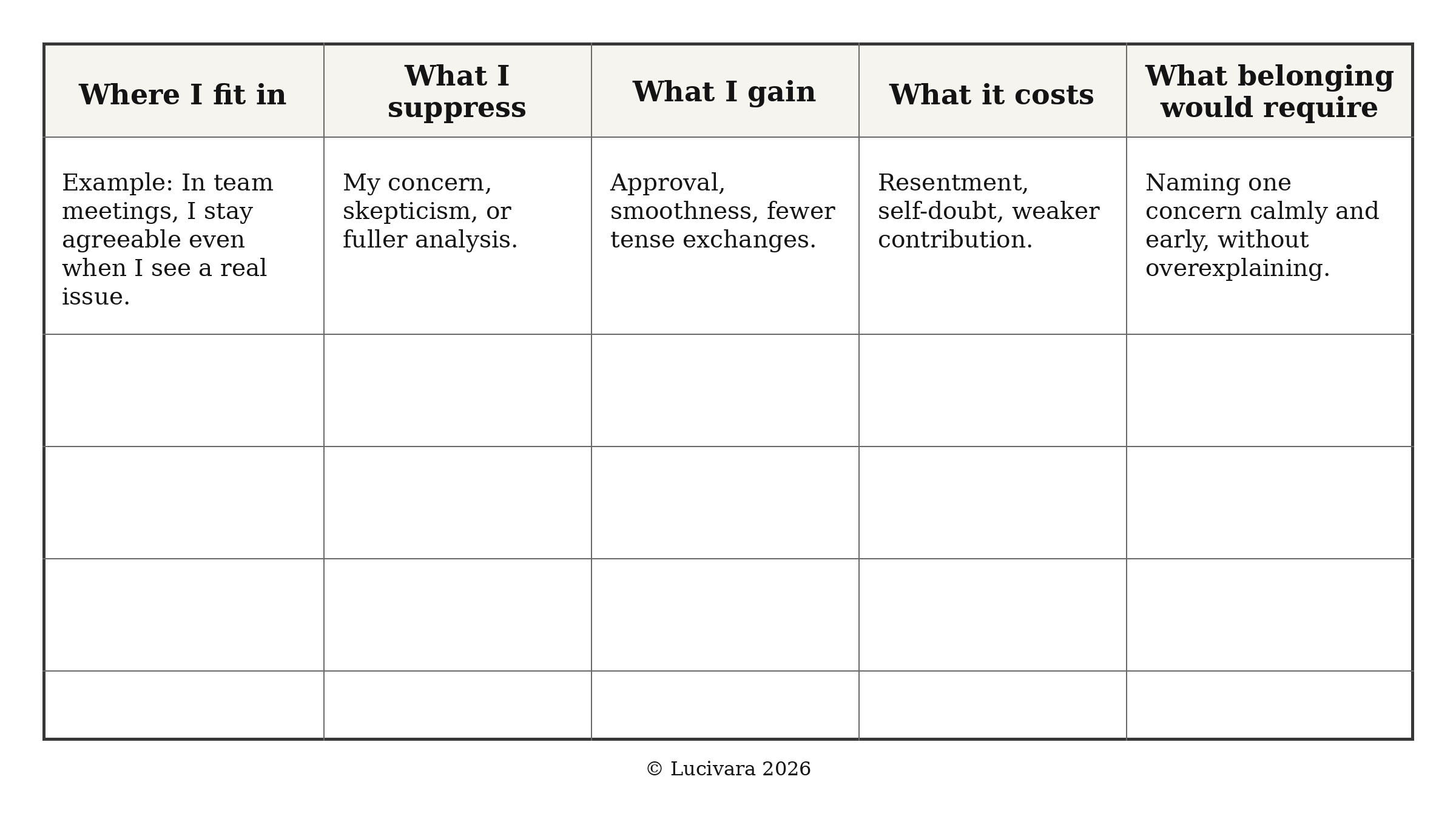
Step 1: Name the setting.
Write down one place where you know how to be accepted. Be specific. Instead of writing “work,” write “weekly leadership meeting.” Instead of writing “family,” write “Sunday dinner with my parents.” Specificity makes the pattern easier to see.
Step 2: Name what you suppress.
Identify what you tend to hide, mute, soften, or edit. It may be disagreement, intelligence, ambition, grief, uncertainty, humor, sensitivity, anger, spiritual questions, creative desire, personal history, boundaries, or needs. Do not overexplain it. Name it plainly.
Step 3: Name what you gain.
Fitting in usually gives something real. It may give approval, ease, safety, access, employment, admiration, family stability, romantic peace, or group continuity. Be honest about the benefit. This keeps the practice from becoming simplistic.
Step 4: Name what it costs.
The cost may be fatigue, resentment, loneliness, anxiety, muted creativity, reduced confidence, emotional distance, or the sense that people like you without really knowing you. Try to make the cost precise. “It drains me” is a start. “It makes me distrust my own perception in that room” is more useful.
Step 5: Name what belonging would require.
Do not make this dramatic. Belonging may require one honest sentence, one clearer boundary, one direct request, one more accurate answer, one less performance of enthusiasm, or one decision to stop laughing at something that violates your values. Choose something small enough to practice.
After completing the table, answer these three self-evaluation questions:
Where have I been calling something belonging when it is actually skilled fitting in?
What part of myself am I most afraid would threaten acceptance if it became more visible?
What is one low-risk act of truthful participation I can practice this week?
A useful answer should leave you with one concrete insight and one doable action. If your answers become vague or punitive, return to the central distinction. Fitting in may have helped you survive. Belonging asks whether a more honest form of connection is now available.
From Survival Strategy to Living Presence
The difference between fitting in and belonging is not meant to accuse anyone. It is meant to make the next choice more visible. Many people learned to fit in long before they had the power to choose otherwise. They learned the moods of adults, the rules of classrooms, the politics of workplaces, the expectations of families, the codes of peer groups, and the penalties of being too much, too quiet, too honest, too intense, too ambitious, too sensitive, or too alive.
Those adaptations may have been necessary. They may have carried a person through years when direct authenticity would have been unsafe, unsupported, or socially impossible. No one should treat an old survival strategy with contempt. A strategy formed under pressure is evidence of intelligence under constraint.
But survival is not the same as belonging. A life cannot remain organized around the question, “Who must I become to be accepted?” without eventually losing contact with its own center. The more mature question is not selfish, reckless, or antisocial. It is simply more honest: “Can I participate without betraying myself?”
That question does not have to be answered everywhere at once. Some rooms will not be ready for your fuller truth. Some relationships may only know the version of you that asks less of them. Some systems may prefer your compliance to your presence. That information is not failure. It is discernment.
Belonging is not only about finding where you are received. It is also about recognizing where you have been required to disappear. Some forms of connection keep the body near while keeping the person hidden. Some forms of approval reward a version of the self that can no longer carry the truth.
July begins here because belonging is a structural need, not a decorative theme. Human beings require connection, but not all connection restores the self. Some connection rewards performance. Some connection depends on silence. Some connection gives proximity without recognition. The task now is to become more exacting about the difference.
Fitting in asks for a manageable version of you. Belonging makes room for the living one.
🧩🧍♀️✨
Bibliography
Asch, S. E. (1955). Opinions and social pressure. Scientific American, 193(5), 31–35. https://doi.org/10.1038/scientificamerican1155-31
Baumeister, R. F., & Leary, M. R. (1995). The need to belong: Desire for interpersonal attachments as a fundamental human motivation. Psychological Bulletin, 117(3), 497–529.
Brown, B. (2017). Braving the wilderness: The quest for true belonging and the courage to stand alone. Random House.
Cialdini, R. B., & Goldstein, N. J. (2004). Social influence: Compliance and conformity. Annual Review of Psychology, 55, 591–621. https://doi.org/10.1146/annurev.psych.55.090902.142015
Deci, E. L., & Ryan, R. M. (2000). The “what” and “why” of goal pursuits: Human needs and the self-determination of behavior. Psychological Inquiry, 11(4), 227–268. https://doi.org/10.1207/S15327965PLI1104_01
Goffman, E. (1959). The presentation of self in everyday life. Doubleday.
Kernis, M. H., & Goldman, B. M. (2006). A multicomponent conceptualization of authenticity: Theory and research. In M. P. Zanna (Ed.), Advances in experimental social psychology (Vol. 38, pp. 283–357). Elsevier. https://doi.org/10.1016/S0065-2601(06)38006-9
Wood, A. M., Linley, P. A., Maltby, J., Baliousis, M., & Joseph, S. (2008). The authentic personality: A theoretical and empirical conceptualization and the development of the Authenticity Scale. Journal of Counseling Psychology, 55(3), 385–399. https://doi.org/10.1037/0022-0167.55.3.385
Legal Disclaimer: The content published on Lucivara is provided for informational, educational, and reflective purposes only. It is not intended to constitute medical, psychological, legal, or professional advice. Readers should not rely on this content as a substitute for consultation with a qualified professional. If you have specific concerns about your health, safety, legal rights, or personal circumstances, you should seek guidance from an appropriately qualified professional.
Copyright Notice: © 2026 Lucivara. All rights reserved. This content is protected by copyright laws and is intended for individual, personal, and non-commercial use only. No part of this publication may be reproduced, distributed, transmitted, displayed, published, or broadcast in any form or by any means without prior written permission from Lucivara.
Acceptable Use: The content published on Lucivara may not be copied, reproduced, redistributed, republished, uploaded, posted, transmitted, stored, scraped, extracted, indexed, modified, translated, summarized, adapted, or used to create derivative works without prior written permission from Lucivara. This includes use in artificial intelligence systems, machine learning models, datasets, search indexes, automated tools, bots, or other commercial or non-commercial systems.
By accessing and using this site, you agree to the Lucivara Terms and Conditions.
