
26.68 - Behavior Is Not Identity
Core Question:
Why must actions be separated from identity in order for responsibility to remain possible?
🧠🔍🧩
Orientation: Behavior Often Gets Mistaken for Identity
Most people do not experience mistakes as simple events. Instead, mistakes are interpreted as evidence of who they are. A missed deadline becomes proof of unreliability. A moment of impatience becomes evidence of being a bad person. A failed attempt becomes confirmation of incompetence.
In these moments behavior collapses into identity. The action is no longer treated as something that happened within a particular situation. It becomes a statement about character.
This shift matters because behavior and identity operate at different levels of experience. Behavior occurs in time. It is shaped by context, fatigue, attention, and the surrounding conditions of a moment. Identity, by contrast, is a narrative that attempts to summarize a person across many moments.
When the distinction disappears, mistakes begin to feel permanent. If behavior reveals identity, each action appears to expose a deeper truth about who someone is. The mind moves quickly from observation to judgment.
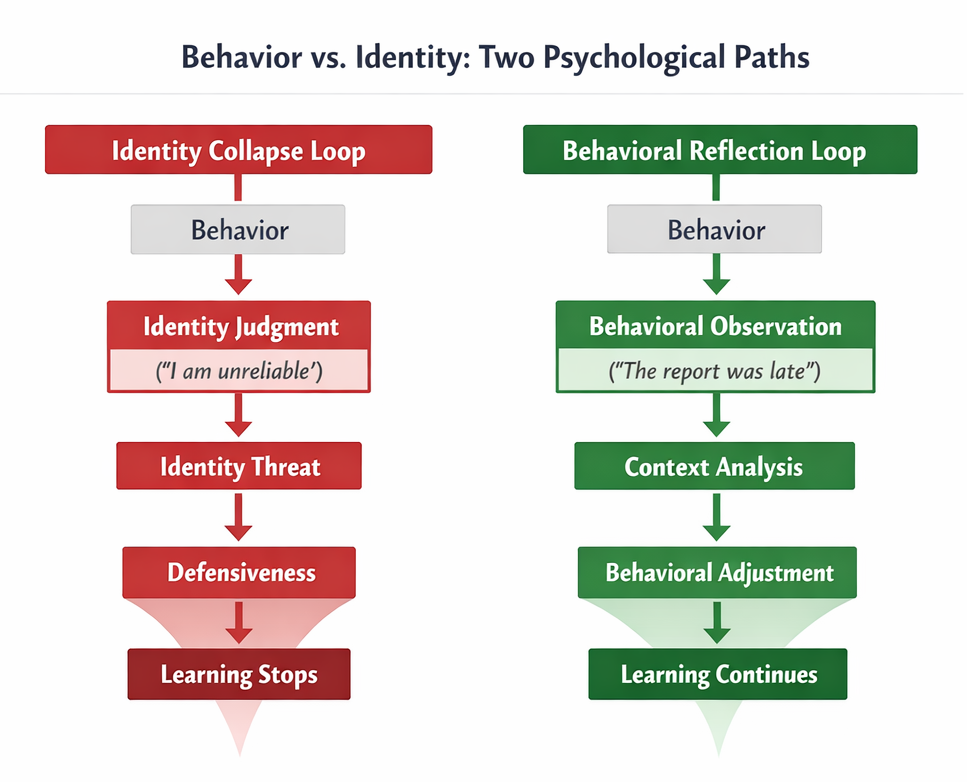
Consider a simple workplace scenario. A manager submits a report late after a week of competing deadlines. The delay is a behavior that occurred within a specific context. Yet the internal interpretation may immediately shift toward identity: “I am unreliable.” Once that label appears, the original event is no longer just a delayed report. It becomes evidence about the self.
This same pattern appears in personal habits. A person who skips a workout may interpret the behavior as proof of laziness rather than as a temporary deviation from routine. A parent who reacts impatiently to a child may interpret the moment as evidence of being a bad parent rather than as a moment of fatigue.
In each case the behavior is real, yet the identity conclusion expands the meaning of the event far beyond the moment itself.
This collapse produces a predictable psychological response. When identity feels threatened, the mind shifts toward defense rather than reflection. People justify behavior, minimize errors, or redirect blame because examining the action feels like accepting a negative label about themselves.
The result is paradoxical. When behavior becomes identity, responsibility becomes harder to accept. The emotional cost of acknowledging mistakes becomes too high.
Separating behavior from identity restores a useful boundary. Actions remain visible and accountable, but the self is not reduced to any single moment. This distinction allows behavior to be examined honestly without turning reflection into self-condemnation.
Responsibility depends on maintaining that separation.
Cultural Backdrop: Performance Culture Encourages Identity Collapse
The tendency to equate behavior with identity has always existed, but contemporary culture intensifies it. Modern social environments place unusual emphasis on personal identity as something that must be displayed and maintained publicly.
Digital platforms amplify this pressure. Individuals are encouraged to express who they are through visible opinions, reactions, and behaviors. Over time these expressions accumulate into a narrative that others interpret as identity.
Within this environment behavior rarely appears as a temporary event. Instead actions are often interpreted as signals of character. A single moment can be used to construct a broader story about who someone truly is.
The speed of digital communication accelerates this process. Online interactions compress complex human experiences into brief, visible fragments. Context disappears while interpretation increases. Observers see behavior but rarely see the conditions surrounding it.
When context is missing, simplified explanations become attractive. If someone behaved poorly, the behavior is treated as evidence of character. If someone behaved well, the action becomes proof of virtue.
Psychologists describe this tendency as the fundamental attribution error, a cognitive bias in which observers overestimate personal traits while underestimating situational influences. When people watch behavior without understanding its context, they instinctively attribute it to character rather than circumstance.
This framework assumes stability where variation actually exists. Human behavior fluctuates across environments, emotional states, and pressures. The same individual can respond very differently depending on context.
Yet cultural narratives prefer stable identity explanations. Fixed stories are easier to communicate than situational complexity.
This pressure makes admitting mistakes socially difficult. If behavior reveals identity, acknowledging an error appears to confirm a negative label. Individuals therefore protect identity narratives even when they privately recognize the behavior was flawed.
Performance culture therefore discourages reflection. Maintaining identity stability becomes more important than examining behavior.
Scientific Context: Research Shows Behavior Is Adaptive and Changeable
Psychological research offers a different framework for understanding behavior. Rather than treating actions as expressions of fixed identity, many research traditions describe behavior as part of an adaptive system shaped by learning and experience.
The work of Carol Dweck illustrates this distinction through studies on implicit theories of ability. Dweck demonstrated that individuals tend to hold one of two beliefs about personal abilities. Some view abilities as fixed traits. Others view abilities as capacities that can develop through effort and learning.
These beliefs strongly influence how people interpret mistakes. When abilities are understood as fixed, failure appears to reveal personal inadequacy. Individuals often withdraw from challenges because errors threaten identity.
When abilities are viewed as developable, failure functions differently. Mistakes provide information about strategy, effort, or conditions rather than defining the person. Because identity remains intact, individuals remain engaged and more willing to adjust behavior.
Attribution research developed by Bernard Weiner helps explain why these interpretations matter. Attribution theory demonstrates that individuals interpret behavior along dimensions such as stability and controllability. When outcomes are attributed to stable internal traits, people feel less capable of changing them. When outcomes are attributed to controllable factors such as effort or strategy, persistence increases.
Research on the fundamental attribution error, pioneered by social psychologists such as Lee Ross, further shows that humans naturally misinterpret behavior by assuming character explanations rather than situational ones. This bias explains why identity collapse feels intuitive even though it often misrepresents reality.
Another research tradition that supports behavioral flexibility is self-determination theory, developed by psychologists Edward Deci and Richard Ryan. Their work identifies three psychological needs that sustain motivation: autonomy, competence, and relatedness. When identity is threatened through criticism or shame, the sense of autonomy collapses and individuals lose motivation to improve behavior. When feedback preserves autonomy, individuals remain more engaged in adjusting their actions.
Neuroscience research reinforces this adaptive model through findings on neuroplasticity. Scientists such as Michael Merzenich have demonstrated that neural circuits reorganize in response to repeated activity. Skills, habits, and emotional responses evolve as patterns of neural activity strengthen or weaken through experience.
This evidence suggests that behavior reflects the current state of a learning system rather than a permanent trait. Repeated actions gradually shape both neural pathways and personal identity beliefs.
In practical terms, identity often emerges from behavior rather than preceding it. Behavioral patterns accumulate over time, gradually influencing how individuals understand themselves.
From this scientific perspective behavior functions as information about how a system is currently operating. It is not a fixed definition of the self.
Mistakes therefore serve as feedback that guides learning rather than evidence of personal deficiency.
Insight: Separating Behavior from Identity Makes Responsibility Safe
Understanding behavior as adaptive rather than defining changes how responsibility operates. Responsibility requires the ability to examine actions honestly, yet that examination becomes difficult when behavior is interpreted as evidence of identity.
When criticism targets identity, people instinctively resist it. Statements such as “you are careless” or “you are selfish” frame behavior as evidence of a permanent trait. The individual experiences the criticism as a threat to self-image.
Under these conditions defensive responses are predictable. People argue, rationalize, or redirect blame because accepting the criticism would imply something negative about who they are.
Behavioral feedback operates differently. When feedback focuses on specific actions, the scope becomes narrower and more manageable.
For example, compare the following two statements:
“You are irresponsible.”
“You submitted the report after the agreed deadline.”
The first statement defines the person. The second describes the behavior.
A similar distinction appears in relationships. Saying “you are selfish” invites argument. Saying “you spoke for most of the conversation without asking questions” identifies a specific behavior that can be examined.
In parenting contexts the difference is equally important. A child who hears “you are lazy” may interpret the statement as a permanent identity judgment. A child who hears “you left the assignment unfinished” receives feedback about a behavior rather than a definition of character.
Specificity changes the emotional meaning of criticism. When behavior is described precisely, individuals can examine the action without experiencing the conversation as condemnation.
This shift creates psychological safety for responsibility. People become more willing to acknowledge mistakes when doing so does not threaten their entire sense of self.
Paradoxically, separating behavior from identity increases accountability. Individuals who feel safe examining their actions become more capable of adjusting them.
Responsibility becomes sustainable because it can occur repeatedly without damaging identity.
Practice: Translate Identity Statements Into Behavioral Language
One practical method for preserving the distinction between behavior and identity involves examining the language used to describe personal mistakes. People often describe behavioral patterns using identity labels. Statements such as “I am terrible at managing time” or “I am bad at conflict” transform repeated actions into descriptions of the self.
This language reinforces identity collapse. If the problem lies in identity, the possibility of change appears limited.
A more precise approach involves translating identity statements into descriptions of behavior. Instead of saying “I am unreliable,” a person might say: “I did not follow through on the commitment I made yesterday.” Instead of saying: “I am bad at difficult conversations,” someone might say: “I avoided addressing the disagreement during the meeting.” This linguistic shift introduces precision. The focus moves from identity to observable action.
A simple reflective process can help reinforce this shift.
First, notice the identity statement that appears after a mistake.
Second, translate the statement into a behavioral description.
Third, examine the conditions surrounding the behavior.
Questions naturally emerge:
What influenced the behavior?
What pressures or distractions were present?
What alternative response might be possible next time?
This process converts self-criticism into investigation. The goal becomes understanding patterns rather than assigning blame. Over time the practice strengthens behavioral awareness. Individuals become more capable of adjusting actions without collapsing into negative identity judgments.
Responsibility therefore becomes an ongoing process of observation and adjustment rather than a verdict about who someone is.
Integration: When Behavior Is Separate from Identity, Accountability Becomes Sustainable
Human development depends on a continuous cycle of action, reflection, and adjustment. For that cycle to function, individuals must feel capable of examining their own behavior honestly. When behavior becomes identity, this process breaks down. Each mistake appears to threaten the self. The mind shifts toward protecting identity rather than learning from experience. Separating behavior from identity restores the conditions necessary for growth. Actions remain accountable, yet the individual is not reduced to those actions.
This distinction allows behavior to be examined with curiosity rather than fear. Mistakes become opportunities to understand patterns, habits, and environmental influences. Over time accountability becomes quieter and more consistent. Individuals adjust behavior gradually in response to experience rather than reacting defensively to criticism.
Personal growth rarely requires redefining the self. More often it requires repeated adjustments to behavior over time. Small behavioral changes accumulate, gradually shaping both habits and identity. Identity remains stable enough to absorb mistakes. Behavior remains flexible enough to change. Responsibility therefore becomes sustainable because it can be practiced repeatedly through reflection and adjustment.
🧠🔍🧩
Bibliography
Dweck, C. S. (2006). Mindset: The new psychology of success. Random House.
Dweck, C. S. (2019). Mindsets: A view from two eras. Perspectives on Psychological Science, 14(3), 481–496.
Doidge, N. (2007). The brain that changes itself: Stories of personal triumph from the frontiers of brain science. Viking.
Merzenich, M. M. (2013). Soft-wired: How the new science of brain plasticity can change your life. Parnassus Publishing.
Weiner, B. (1985). An attributional theory of achievement motivation and emotion. Psychological Review, 92(4), 548–573. https://doi.org/10.1037/0033-295X.92.4.548
Weiner, B. (1995). Judgments of responsibility: A foundation for a theory of social conduct. Guilford Press.
Yeager, D. S., & Dweck, C. S. (2012). Mindsets that promote resilience: When students believe that personal characteristics can be developed. Educational Psychologist, 47(4), 302–314.
Ryan, R. M., & Deci, E. L. (2000). Intrinsic and extrinsic motivations: Classic definitions and new directions. Contemporary Educational Psychology, 25(1), 54–67.
Ross, L. (1977). The intuitive psychologist and his shortcomings: Distortions in the attribution process. In L. Berkowitz (Ed.), Advances in experimental social psychology (Vol. 10, pp. 173–220). Academic Press.
Clear, J. (2018). Atomic habits: An easy and proven way to build good habits and break bad ones. Avery.
Legal Disclaimer: The content published on Lucivara is provided for informational, educational, and reflective purposes only and is not intended to constitute medical, psychological, legal, or professional advice. Lucivara does not diagnose conditions, prescribe treatments, or provide therapeutic or professional services. Readers are encouraged to consult qualified professionals regarding any personal, medical, psychological, or legal concerns. Use of this content is at the reader’s own discretion and risk.
Copyright Notice: © Lucivara. All rights reserved. All content published on Lucivara, including text, images, graphics, and original concepts, is protected by copyright law. This content may not be reproduced, distributed, transmitted, displayed, modified, or otherwise used, in whole or in part, without prior written permission from Lucivara, except where permitted by applicable law.
Acceptable Use: This content is provided for personal reading and reflection only. Automated scraping, reproduction, modification, redistribution, or use of this material in artificial intelligence training systems, datasets, or derivative works without prior written permission from Lucivara is strictly prohibited.
By accessing or using this site, readers acknowledge and agree to Lucivara’s Terms and Conditions.
