
26.105 - Untracked Work
Core Question
What work are you doing that is real but not measured?
🎯🧾🔍
The Day That Leaves No Record
There are days that feel full in a way that is difficult to account for. You move through conversations that require constant adjustment, interpreting what people mean before they fully express it and responding in ways that keep things aligned. You prevent misunderstandings before they become visible. You absorb tension that might otherwise escalate. You reorganize information so that others can move forward more easily, even if they never notice that anything changed. The work is continuous, responsive, and necessary.
By the end of the day, there is a sense that something substantial has been carried. The effort is felt in attention and fatigue. Yet when you attempt to describe what was accomplished, the account feels incomplete. There is no finished artifact that captures the day. There is no clear output that summarizes what took place. The day appears lighter than it was.
This creates a quiet dissonance. The experience of work is high, but the visible record is low. Over time, this gap begins to influence interpretation. You may start to question whether the work counted. You may find yourself preferring tasks that produce something you can point to, even when those tasks are not the most necessary. The pressure is not always external. It becomes internal, shaping what feels legitimate to call work.
The difficulty is not that the work lacks value. It is that the work dissolves into the conditions it creates. Once alignment is maintained, there is nothing to show. Once a problem is prevented, there is no event to reference. The work disappears as it succeeds, leaving behind continuity rather than evidence.
How Systems Reward What Can Be Shown
Most systems that organize work rely on measurement. Outputs can be counted, compared, and evaluated. Deliverables create a shared reference point that allows coordination across people and time. This structure is necessary, but it introduces a directional bias.
When contribution is defined through what can be shown, work begins to separate into two categories. Performable work produces artifacts that can be displayed and evaluated. Non-performable work manages conditions, stabilizes interactions, and prevents disruption. It rarely produces something that can be presented as evidence.
This distinction influences behavior over time. Individuals begin to orient their effort toward what can be seen and recognized. Work that produces visible results becomes easier to justify. Work that does not becomes harder to explain, even when it is essential. As a result, attention shifts toward outputs and away from the conditions that make those outputs possible.
This dynamic becomes self-reinforcing. Systems reward visible output, which encourages individuals to prioritize it. As individuals prioritize what is visible, systems continue to privilege what can be measured. The definition of contribution narrows. Work that maintains stability remains necessary, but it becomes peripheral in how value is perceived.
This shift is not only external. It becomes internalized. People begin to evaluate their own effort using the same criteria. If there is no artifact, the day feels incomplete. If there is nothing to show, the work feels less real. Over time, identity becomes tied to visible production rather than to the full scope of contribution.
Why Invisible Work Is Systematically Undervalued
The undervaluation of untracked work is not incidental. It emerges from the interaction between organizational systems and human cognition.
At the organizational level, research by Lotte Bailyn at the Massachusetts Institute of Technology demonstrates that traditional performance structures privilege visible productivity while overlooking relational and integrative forms of work. These include coordination, alignment, and maintenance activities that sustain system function but do not produce discrete outputs. Because these contributions are difficult to quantify, they are often excluded from evaluation systems, creating a persistent measurement bias.
Arlie Hochschild’s work on emotional labor further identifies a category of effort that operates through regulation rather than production. Managing one’s own emotional state and influencing the emotional conditions of others requires sustained attention and control. This work is foundational to maintaining functional environments, yet it is frequently treated as secondary because it does not generate a tangible artifact.
At the cognitive level, research by Daniel Kahneman and Amos Tversky explains why individuals reinforce this bias. The availability heuristic leads people to assign greater importance to what is easily recalled. Visible outputs are easier to remember and therefore appear more significant. Work that does not produce a clear signal is less accessible to memory and is consequently undervalued.
Salience bias amplifies this effect. Events that stand out capture attention and are given disproportionate weight in evaluation. Continuous, low-visibility effort does not stand out. It blends into the background, making it less likely to be recognized as meaningful. Over time, this produces a distorted perception of where effort is actually being applied.
Herbert Simon’s work on attention economics provides an additional explanation. In environments with limited attention, both individuals and systems prioritize signals that are easiest to process. Measurable outputs provide clear and efficient signals, while invisible work requires interpretation. As a result, attention is allocated toward outputs, and less visible forms of contribution are overlooked.
Goodhart’s Law, often summarized as “what gets measured gets managed,” explains how measurement reshapes behavior. When metrics become the primary mechanism for evaluating value, effort shifts toward optimizing those metrics. Work that contributes to system stability but does not directly influence measurable outcomes is deprioritized, even when it is essential for long-term performance.
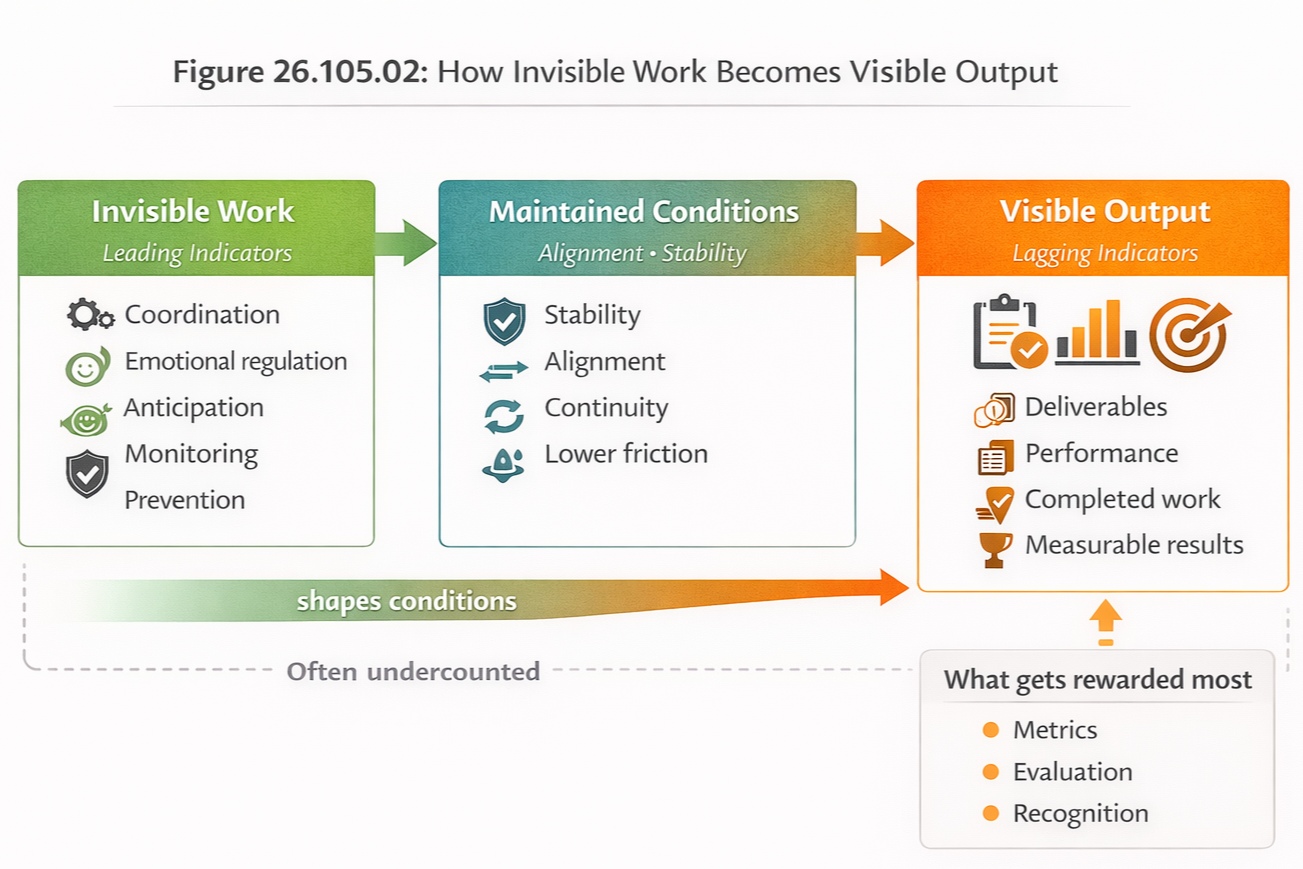
A further distinction can be made between leading and lagging indicators. Visible outputs are typically lagging indicators. They reflect the result of prior conditions. Invisible work, such as maintenance, alignment, and prevention, operates as a leading indicator. It shapes the conditions that determine whether outputs will be successful. Because leading indicators are less visible, they are often undervalued despite their predictive importance.
Outcome bias reinforces this pattern. People evaluate actions based on visible results rather than on the quality of the process or the conditions that were maintained. When systems function smoothly, the absence of problems is rarely interpreted as evidence of effective work. It is treated as a baseline rather than as an outcome.
Research in systems theory and reliability engineering challenges this assumption. Complex systems remain stable through continuous adjustment. Small corrections, monitoring, and preventative interventions are what keep systems functioning. These activities do not produce visible change precisely because they are effective. Their success is measured by what does not happen.
When these forms of work are removed, failure becomes visible. Misalignment increases, errors accumulate, and breakdown occurs. Only then does the previously invisible effort become apparent. Across domains, the pattern is consistent. Work that produces visible output is overrepresented in evaluation. Work that maintains conditions or prevents failure is underrepresented.
Contribution as the Absence of Breakdown
Contribution is often defined through what is produced. A completed task or a measurable result becomes the evidence of work. This definition is incomplete.
Contribution is not only what produces visible output. It is also what maintains conditions and prevents breakdown.
A conversation that remains constructive rather than fragmenting reflects work that stabilized the interaction. A process that continues without interruption reflects work that preserved alignment. A system that operates without visible strain reflects ongoing adjustments that prevented failure. These outcomes do not draw attention because they appear normal, yet they are actively maintained.
This form of work is preservative rather than additive. It does not create something new that can be pointed to. It ensures that what already exists continues to function. Because it produces continuity rather than change, it leaves no artifact. As a result, it is often excluded from how contribution is defined.
Reframing contribution requires expanding beyond output. It involves recognizing that maintaining conditions and preventing breakdown are primary forms of work. They are not secondary to visible results. They are what make visible results possible.
Listing Work That Leaves No Artifact
The purpose of this exercise is to make untracked work visible to your own attention. It is not designed to justify or present your effort. It is designed to correct perception.
Begin with a recent day and reconstruct it in sequence rather than in summary. Move through the day hour by hour, focusing on moments where effort was required but no clear output was produced. Pay attention to interactions, adjustments, and decisions that did not result in something you could point to.
Write down instances such as clarifying expectations before confusion formed, adjusting communication to maintain alignment, absorbing tension rather than escalating it, organizing information for future use, or noticing potential issues and addressing them early. Include moments of internal regulation where you chose restraint, recalibrated your response, or maintained steadiness under pressure.
As the list develops, actively challenge your filtering process. What did you initially leave out? What felt too small or too informal to count? What would you hesitate to report if someone else were reviewing your day? Include these items deliberately. They often represent the most consistently overlooked forms of work.
Expand the list beyond task-oriented activity. Include relational maintenance, coordination across people or systems, anticipation of future needs, and preventative actions that avoided problems. These forms of work rarely produce immediate outcomes, but they shape what becomes possible.
Once complete, review the list without condensing it. If it resembles a clean task list, it is incomplete. If it includes internal, relational, and preventative effort, it is closer to accurate.
Detecting What You Exclude
The effectiveness of this exercise depends on your ability to notice what you exclude. Filtering often occurs automatically. Work that does not resemble formal output is dismissed before it is recorded, reproducing the same bias that exists in external systems.
If your list feels concise, structured, and easy to defend, it likely reflects only what is already considered legitimate. If it feels uneven, excessive, or difficult to justify, it is more likely to represent the full scope of your effort. The discomfort is part of the calibration.
Pay attention to hesitation. When you question whether something should be included, treat that hesitation as a signal. Include the item rather than removing it. If the list captures only what you would confidently present, it is incomplete. If it captures what you would normally minimize, it is more accurate.
The objective is not to assign equal importance to every action. It is to correct the field of visibility so that evaluation becomes more accurate. Without this correction, contribution will continue to appear smaller than it is, not because the work is lacking, but because much of it is not being seen.
Expanding What Counts as Work
This shift does not change how systems immediately evaluate contribution. Metrics will continue to privilege visible outputs, and those outputs will continue to matter. The adjustment is not to reject measurement, but to place it within a broader understanding of work.
As untracked work becomes visible to you, the interpretation of a day begins to change. A day without a clear artifact is no longer experienced as empty. It is understood as a day in which conditions were stabilized, alignment was maintained, and potential problems were prevented. The absence of disruption becomes meaningful.
This shift alters how effort is perceived in real time. You begin to notice the work that keeps things functioning while it is happening, rather than only recognizing it in hindsight. Conversations that remain steady, processes that continue smoothly, and systems that do not break are no longer neutral events. They become evidence of ongoing contribution.
Over time, this expands the definition of meaningful work. Contribution is no longer limited to what can be displayed. It includes what allows things to keep working. It includes the adjustments that go unnoticed, the stability that is assumed, and the prevention that leaves no trace.
What changes is not the amount of work you do, but what you are able to see. As that visibility increases, the sense of what constitutes a productive day becomes more accurate. Contribution becomes less about what can be shown and more about what continues because of your effort.
🎯🧾🔍
Bibliography
Bailyn, L. (1993). Breaking the mold: Women, men, and time in the new corporate world. Free Press.
Hochschild, A. R. (1983). The managed heart: Commercialization of human feeling. University of California Press.
Kahneman, D. (2011). Thinking, fast and slow. Farrar, Straus and Giroux.
Simon, H. A. (1971). Designing organizations for an information-rich world. In M. Greenberger (Ed.), Computers, communications, and the public interest (pp. 37–52). Johns Hopkins Press.
Tversky, A., & Kahneman, D. (1974). Judgment under uncertainty: Heuristics and biases. Science, 185(4157), 1124–1131. https://doi.org/10.1126/science.185.4157.1124
Legal Disclaimer: The content published on Lucivara is provided for informational, educational, and reflective purposes only and is not intended to constitute medical, psychological, legal, or professional advice. Lucivara does not diagnose conditions, prescribe treatments, or provide therapeutic or professional services. Readers are encouraged to consult qualified professionals regarding any personal, medical, psychological, or legal concerns. Use of this content is at the reader’s own discretion and risk.
Copyright Notice: © 2026 Lucivara. All rights reserved. This content is protected by applicable copyright and intellectual property laws and is intended for personal, non-commercial use only.
Acceptable Use: The content published on Lucivara is intended for individual, personal, and non-commercial use only. Readers may access, read, and engage with the content for their own reflective, educational, or informational purposes. Except for such ordinary human use, no portion of this content may be copied, reproduced, redistributed, republished, transmitted, stored, scraped, extracted, indexed, modified, translated, summarized, adapted, or incorporated into derivative works without prior written permission from Lucivara. This restriction expressly includes, without limitation, the use of Lucivara content for training, fine-tuning, prompting, testing, benchmarking, or operating artificial intelligence systems, machine learning models, automated agents, bots, or any other computational or data-driven systems, whether commercial or non-commercial.
By accessing or using this site, readers acknowledge and agree to Lucivara’s Terms and Conditions.
