
26.104 - Role, Not Identity
Core Question
What is your role today?
🧭🎭🪞
Roles Become Identity When Left Unexamined
Most people do not consciously decide to confuse who they are with what they are doing. The confusion accumulates gradually. It enters through repetition, responsibility, praise, and the quiet efficiency of social life. A person becomes the reliable one, the leader, the caretaker, the problem solver, the expert. At first these are functions. Over time they solidify into a personal narrative.
This is where modern life becomes psychologically sticky. Roles are necessary. They coordinate behavior, reduce ambiguity, and allow systems to function. Yet the same structure that creates order can create distortion. A role can expand until it begins to feel like identity itself. When that happens, change feels threatening even when appropriate. Rest feels like failure. Boundaries feel like defects.
The cost is subtle. Over-identification often looks admirable from the outside. The fused individual is praised for consistency, discipline, or endurance. The role appears stable. The interior becomes less stable. This is how roles leak across environments. The manager speaks to a partner like a subordinate. The caretaker cannot stop scanning for needs. The competent one cannot ask for help. The role continues after the context has ended.
This pattern is reinforced through feedback loops. When a person performs a role effectively, they are rewarded. The reward increases the likelihood of repetition. Over time, repetition becomes expectation. Eventually, expectation becomes identity. The individual is no longer choosing the role. The role is operating automatically, both socially and internally.
There is also a subtle narrowing effect. As a role becomes dominant, alternative behaviors become less visible. The person stops considering other ways of responding because the familiar role feels efficient and correct. This efficiency comes at a cost. It reduces adaptability and increases rigidity. The person becomes highly effective in one mode and increasingly limited outside of it.
The issue is not that roles exist. The issue is that most people have never learned to hold a role lightly. They enter a room and unconsciously ask what version of themselves will make the situation work. Then they continue being that version after the room has changed. The role becomes sticky. The self becomes obscured.
The better question is smaller and more precise. Not who am I in total. Not what do others expect. But what is my role today? The question introduces proportion. It restores context. It reminds the mind that a role is something inhabited, not something possessed.
Culture Rewards Identity Inflation and Punishes Flexibility
Contemporary culture encourages a steady fusion between role and self. People are expected to define, brand, and present themselves consistently across environments. This expectation is not limited to work. It extends into relationships, creativity, and personal identity.
Consistency makes people legible. Legibility makes people easier to interpret. Interpretation makes people easier to place within systems. This is efficient. It is also flattening. Complexity is reduced to recognizable identities that can be categorized and managed.
This pressure changes how transitions are experienced. Instead of asking what a situation requires, people ask which version of themselves must remain intact. The parent cannot relax because seriousness has become identity. The leader cannot express uncertainty because certainty has become expectation. The helper cannot receive. The high performer cannot slow down without feeling diminished.
The expectation of continuity also distorts development across time. A role that was useful in one phase of life persists into another where it no longer fits. The responsible child becomes the over-functioning adult. The early-career striver becomes the permanently overextended professional. The accommodating partner becomes the self-suppressing one. These transitions are rarely conscious. They are inherited patterns that continue because they have been rewarded in the past.
There is also a social cost to changing roles. When someone adjusts their behavior, others often experience that adjustment as inconsistency. The person who stops over-delivering may be perceived as less committed. The person who becomes more direct may be seen as difficult. The person who sets boundaries may be labeled distant. These reactions create friction, and many people interpret that friction as evidence that the change is wrong rather than necessary.
Social media amplifies this effect by turning identity into a repeated display. Even without active performance, the architecture encourages internal consistency. A coherent identity becomes easier to narrate and maintain. However, narrative consistency is not the same as psychological flexibility. The human system is designed to respond to context, not to maintain a fixed presentation across all environments.
The hidden cost of identity inflation is reduced adaptability. A person becomes attached to being recognized in a specific way. Belonging becomes tied to continued role performance. The role becomes a tax paid to preserve relational stability.
The more disciplined frame is simpler. Roles matter because contexts matter. Yet no role should expand to define the entire person. The self must remain larger than any one function. Otherwise, every change feels like loss.
Behavior Is Shaped by Roles, Expectations, and Situations
Psychological research consistently shows that behavior is context-sensitive. Human beings are not static expressions of an internal core. They are responsive to environments, expectations, and social structures.
Role theory describes how positions carry behavioral expectations. A role includes duties, permissions, and constraints tied to a situation. Parent, teacher, leader, friend. These roles allow rapid coordination, but they also influence behavior in ways that can override personal preference.
Erving Goffman’s work on social presentation demonstrated that individuals adjust behavior based on audience and setting. This is not deception. It is functional adaptation. Different environments call forward different aspects of the self, and this variation is a sign of social competence rather than inconsistency.
Philip Zimbardo’s Stanford Prison Experiment illustrated how quickly individuals internalize assigned roles under strong situational pressure. Participants adopted behaviors aligned with their assigned roles even when those behaviors conflicted with their prior self-concept. The study remains controversial, but its central insight is clear. Context can override intention with surprising speed.
Hazel Markus’ research on self-schema theory shows that identity is structured through repeated patterns of thought and behavior. These schemas guide perception and action. When one schema becomes dominant, it filters experience in a way that reinforces itself. This creates stability, but it also reduces flexibility.
Roy Baumeister’s work on identity and self-regulation highlights that individuals rely on stable internal structures to guide behavior. When identity becomes over-concentrated in a single domain, disruption in that domain produces disproportionate strain. This is why role loss or role change can feel destabilizing even when it is appropriate.
Research on situational strength further explains why behavior narrows in structured environments. When norms are strong and expectations are clear, alternative responses become less accessible. The role becomes dominant because deviation carries cost.
Cognitive load theory adds another layer. Once a role is activated, it reduces the number of decisions a person must make. This increases efficiency, but it also increases persistence. The mind prefers to continue operating within a known pattern rather than expend energy recalibrating. As a result, roles often extend beyond their useful context simply because they are easier to maintain than to adjust.
Taken together, these findings point to a consistent conclusion. Behavior is shaped by context. Roles are powerful. Yet healthy functioning depends on maintaining separation between situational roles and underlying identity.
Identity Stabilizes While Roles Adapt to Context
The distinction is practical. Identity is the stabilizing layer. Role is the situational assignment.
Identity answers enduring questions. What values remain consistent across contexts? What qualities define how I move through the world? What principles guide behavior regardless of environment?
Role answers contextual questions. What is needed here? What function am I serving? What level of clarity, care, or authority does this situation require?
When these layers are confused, rigidity emerges. A temporary assignment becomes a permanent definition. Adaptation begins to feel like self-loss.
A clearer internal structure sounds like this. In this meeting, my role is to clarify and decide. At home, my role is to listen. In this conversation, my role is to speak directly without over-explaining. In this season, my role is to learn.
These statements preserve flexibility. They allow behavior to adjust without destabilizing identity.
Many conflicts are misinterpreted as identity crises when they are actually role misalignments. A parent needs to shift into an adult-to-adult relationship. A leader needs to delegate rather than carry. A friend needs to stop over-functioning. A person needs to operate from actual capacity rather than perceived expectation.
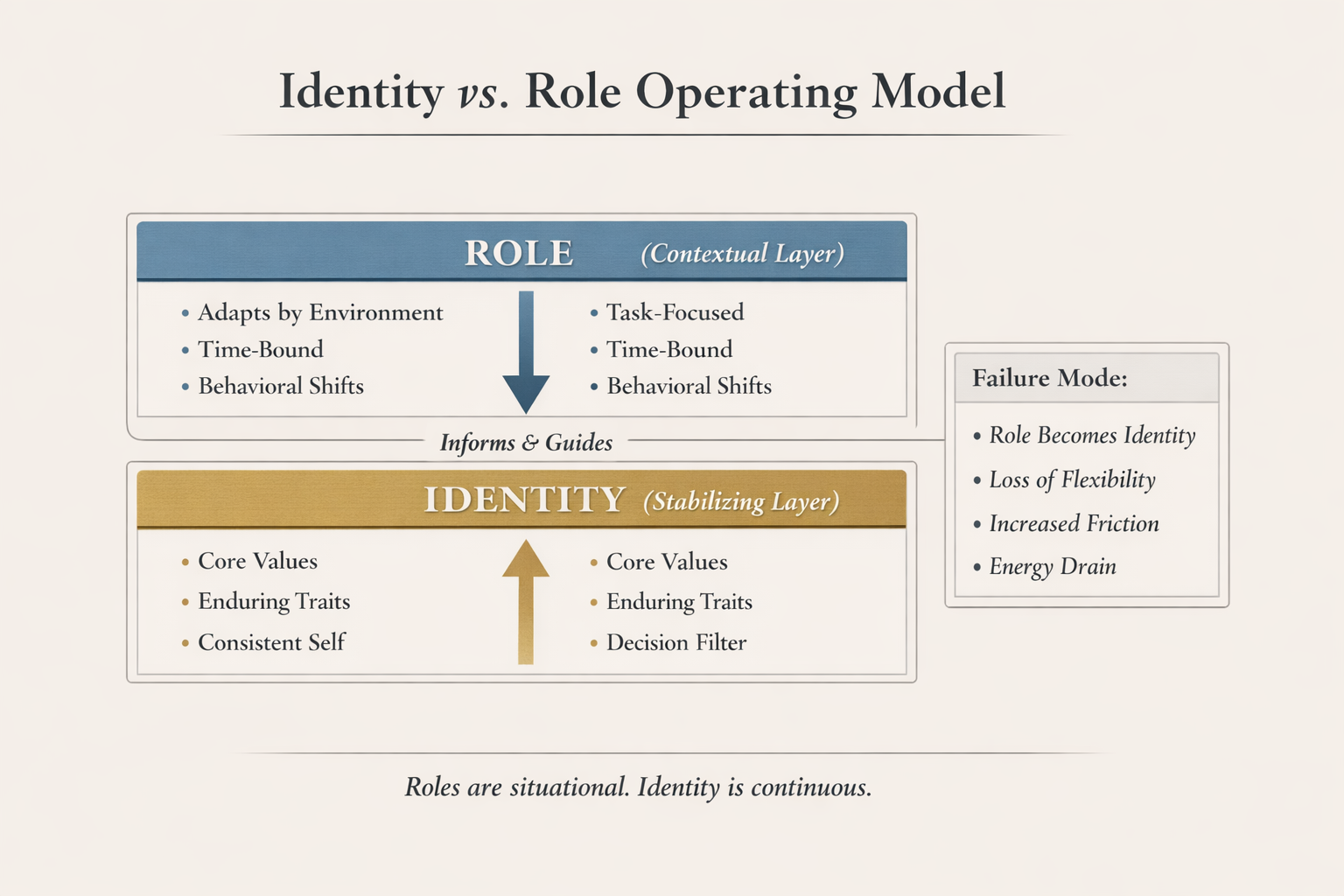
Figure 26.104.02
These are role adjustments, not identity threats. They feel difficult because they disrupt established patterns, not because they threaten the core self.
Roles change. Identity stabilizes. A mature system learns to enter and exit roles with awareness. This preserves energy, increases precision, and reduces unnecessary strain.
Define the Role Before the Environment Defines It for You
Before entering a meaningful context, define your role deliberately.
For each major environment in your day, write one sentence:
My role here is to…
Keep it specific and behavioral.
Examples:
My role in this meeting is to ask clarifying questions and make one decision.
My role with my child tonight is to be present, not efficient.
My role during this work block is to produce, not evaluate.
My role in this conversation is to speak directly and listen fully.
My role this weekend is to recover, not optimize.
Then add:
This role is temporary.
This prevents inflation and supports transition.
Then add:
What remains true about me across contexts is…
Name one or two stabilizing qualities. For example: steadiness, honesty, curiosity, discipline.
During the day, notice friction. Friction usually signals one of three issues: (1) The role is unclear, (2) The role is outdated AND/OR (3) A previous role is being carried into a new context
At the end of the day, review:
Where did I define my role clearly?
Where did I default into a role unconsciously?
Where did a role persist beyond its context?
Which roles felt accurate?
Which roles felt inflated?
Over time, this practice builds situational awareness. Instead of reacting automatically, the person begins to operate with intention. This reduces unnecessary effort and increases alignment between behavior and context.
Calibration: You notice reduced friction between environments and less carryover of tone, urgency, or posture from one context to another.
Stability Comes From Identity, Not Repetition
There is a quiet freedom in not needing to be the same in every environment. Not because the self is fragmented, but because it is differentiated.
A stable identity does not require behavioral sameness. It requires coherence at the level of values. Roles can shift without destabilizing the person when identity remains intact.
Modern life requires multiple roles. The question is whether those roles remain tools or become constraints. Awareness determines the difference. Once a role is named, it becomes something that can be entered and exited deliberately.
Many people experience unnecessary fatigue because they carry the wrong role into the wrong environment. They continue managing when they need to relate. They continue proving when they need to recover. They continue containing when they need to speak. They continue optimizing when they need to pause. These patterns persist not because they are necessary, but because they have become habitual.
This is not a problem of effort. It is a problem of mismatch. When role and context are aligned, effort feels proportional. When they are misaligned, effort feels excessive and unproductive.
The question, what is my role today, restores proportion. It places context back into the equation. It reduces unnecessary psychological load. It protects the distinction between usefulness and identity.
Flexibility is not a failure of selfhood. It is evidence of stability. The rigid system clings to one mode. The stable system adapts without losing coherence.
What remains is not the role, but the person capable of choosing the next one.
And when the moment ends, let the role end too.
🧭🎭🪞
Bibliography
Ashforth, B. E. (2001). Role transitions in organizational life: An identity-based perspective. Lawrence Erlbaum Associates.
Baumeister, R. F. (1998). The self. In D. Gilbert et al. (Eds.), Handbook of social psychology. McGraw-Hill.
Burke, P. J., & Stets, J. E. (2009). Identity theory. Oxford University Press.
Goffman, E. (1959). The presentation of self in everyday life. Doubleday.
Markus, H. (1977). Self-schemata and processing information about the self. Journal of Personality and Social Psychology.
Zimbardo, P. (1971). The power and pathology of imprisonment.
Legal Disclaimer: The content published on Lucivara is provided for informational, educational, and reflective purposes only and is not intended to constitute medical, psychological, legal, or professional advice. Lucivara does not diagnose conditions, prescribe treatments, or provide therapeutic or professional services. Readers are encouraged to consult qualified professionals regarding any personal, medical, psychological, or legal concerns. Use of this content is at the reader’s own discretion and risk.
Copyright Notice: Copyright © 2026 Lucivara. All rights reserved. All content on this site, including text, images, graphics, and original intellectual property, is protected by applicable copyright and other intellectual property laws. No portion of this site may be reproduced, distributed, transmitted, displayed, published, or exploited without prior written permission from Lucivara, except as permitted by law.
Acceptable Use: The content published on Lucivara is intended for individual, personal, and non-commercial use only. Readers may access, read, and engage with the content for their own reflective, educational, or informational purposes. Except for such ordinary human use, no portion of this content may be copied, reproduced, redistributed, republished, transmitted, stored, scraped, extracted, indexed, modified, translated, summarized, adapted, or incorporated into derivative works without prior written permission from Lucivara. This restriction expressly includes, without limitation, the use of Lucivara content for training, fine-tuning, prompting, testing, benchmarking, or operating artificial intelligence systems, machine learning models, automated agents, bots, or any other computational or data-driven systems, whether commercial or non-commercial.
By accessing or using this site, readers acknowledge and agree to Lucivara’s Terms and Conditions.
